Biblical Worldview in History
If God is truly all-knowing, all-present, and all-powerful, it is not a far-fetched belief that God is sovereign over time, nations and the world. It is a principle belief in Liberty University’s History Department. John Fea also states that he believes so in Why Study History, citing Psalms 103 and 147 as examples (Why Study History, 4). This is a very important belief for a Christian, but also one that can me misused as a historian. While God’s actions are everywhere, and all of history is leading toward God’s ultimate and glorious purpose, one must be cautious in trying to shove an interpretation of scripture into everything. Dr. Sam Smith warns that it is not sufficient as a worldview to overspiritualize history, only study history about Christians, or pretend to know for sure what God is doing with a particular historical event (Video presentation: Worldview and History). Likewise, one must be careful in looking forward to future events based on either history or scripture. We are not prophets, and fortune tellers are pagan.

In a move that almost attempts to copy Constantine. Oliver Cromwell attempted a campaign against the Catholic Spanish based on what he hoped was God’s will (Why Study History, 4). This was not Judges chapter 7, and Cromwell was not Gideon. The campaign, and Cromwell’s attempt to “usher in the end of the world as described in the New Testament book of Revelation” was a failure (Why Study History, 4). God was acting in that historical battle, just not in the way Cromwell attempted to either predict or demand (Why Study History, 4).
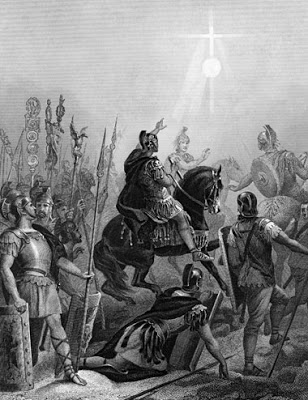
God intended for Constantine to become emperor of Rome. However, Augustine of Hippo reminds us that God also intended for Rome to someday fall. God’s ideas and plans are His alone, and He reveals them in His own time.
John Fea claims that a when Christian’s look for God’s “general providence” over all history, they are often forgetting that history is an expression of humanity’s character, while providence is an expression of God’s (Why Study History, 4).
It is important to remember that both are in action at once. We are made in God’s image, the Imago Dei, but we are also fallen and sinful (Why Study History, 5). As such, the historian is tasked first with explaining and understanding what happened in the past, not judging it morally (Why Study History, 5).
At the end of the day, God knows what He is doing with history better than we do, and we will learn what He wants us to know when He wants us to know it. The Bible already has explanations for what in history is right or wrong, and John Calvin’s instruction is to use that as the lens for viewing the past (Video presentation: Worldview and History).

 HIST 491-B02 Micah Figgers L28131914